NOMAD POWER SOLUTIONS, INC. · NASDAQ: NMAD · BOCA RATON, FL · FORMERLY LIXTE BIOTECHNOLOGY HOLDINGS
Disclaimer
Nothing on this page is personalized financial advice. The Tape is not licensed under securities laws to address your particular financial situation, and no communication from us should be treated as personalized advice. This page is strictly informational and is never to be construed as research. It is neither an offer nor a recommendation to buy or sell any security. We hold no investment licenses and are not qualified to provide investment advice. All readers are strongly urged to perform their own research and due diligence, and to consult a licensed financial professional, before considering any investment in stocks. Investors may lose all or part of their investment when investing in stocks.
This page is published by the Tape. Persons associated with the Tape may have business relationships with NOMAD Power Solutions, Inc. or its subsidiaries, including in connection with the sale of its products, and may receive compensation from those relationships. Readers should assume the Tape is not independent of the Company. The Tape is not a registered broker-dealer, investment adviser, or securities firm. The Tape and its operators may hold, buy or sell shares of NOMAD Power Solutions, Inc. at any time without notice. Third parties who hold shares may liquidate them, which could negatively affect the stock price.
While information here is believed to be reliable, it is not guaranteed by us to be accurate. Readers should assume all information is not trustworthy unless independently verified. Because events frequently do not occur as expected, there will likely be differences between any predictions and actual results.
Cautionary note regarding the acquisition and financial information
NOMAD Power Solutions, Inc. was formerly LIXTE Biotechnology Holdings, Inc., a clinical-stage pharmaceutical company. On June 12, 2026 the Company agreed to acquire NOMAD Transportable Power Systems, Inc.; the acquisition closed on July 1, 2026, the Company was renamed effective July 3, 2026, and it began trading as NMAD on July 6, 2026. The Company has said it is exploring strategic alternatives for its legacy pharmaceutical and med-tech operations. Because NOMAD Transportable Power Systems is the accounting acquirer, financial figures for the operating business referenced here are drawn from the Company's amended Form 8-K filed September 17, 2026, which includes audited financial statements for 2025 and 2024 and unaudited statements for the six months ended June 30, 2026. Those statements reported revenue of approximately $9.35 million for 2025 and $2.35 million for 2024, a gross loss for 2025, revenue of approximately $0.62 million for the six months ended June 30, 2026, a net loss of approximately $153.6 million for that period (including approximately $148.6 million of non-cash charges related to warrant liabilities), deferred revenue of approximately $8.8 million as of June 30, 2026, and substantial doubt about the business's ability to continue as a going concern. The Company's Form 10-Q for the quarter ended June 30, 2026 reflects the legacy pharmaceutical company only. On September 28, 2026 the Company issued a $6.57 million original-issue-discount secured promissory note for gross proceeds of $6.0 million. Review the Company's filings at www.sec.gov in full and do not rely on summary figures presented here.
Key risks
The Company's sales have been uneven: revenue was approximately $9.35 million in 2025 and approximately $0.62 million in the six months ended June 30, 2026, and the business sold its 2025 units at a gross loss. The Company has disclosed substantial doubt about its ability to continue as a going concern and is likely to need additional capital, which may dilute existing shareholders; its September 2026 secured note allows the holder to require redemptions of up to $800,000 per month beginning six months after issuance. Approximately 99% of deferred revenue as of June 30, 2026 was attributable to five customers. The Company competes with other mobile battery providers, equipment-rental companies and stationary battery manufacturers, many with greater resources. U.S. Department of Energy funding is paid by phase and milestone and is not assured. The Company became public through a 2026 reverse merger, has a limited public operating history, and its stock may be volatile and thinly traded. See the risk factors in the Company's SEC filings.
Cautionary note regarding products, deployments and programs
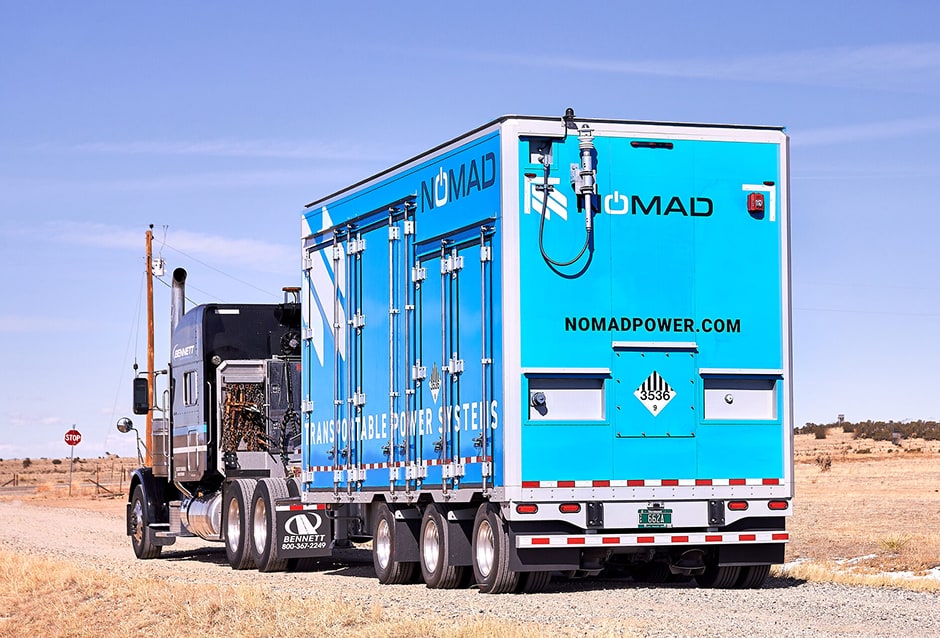
Product specifications, deployment times, deployment counts and categories, uptime figures and capacity increases referenced here are as described by the Company and have not been independently verified by the Tape. "Deployment" time describes on-site commissioning of a delivered unit and excludes manufacturing, transport, permitting, site preparation and utility coordination. Deployments may include pilots, demonstrations, rentals and events as well as commercial sales, and are not a measure of revenue. The approximately $19 million Vermont Long Duration Energy Storage Demonstration Project is a U.S. Department of Energy demonstration program advancing by phase; authorization to advance into a phase is not a commercial contract, and no assurance is given as to funding, completion or outcome. Comparisons to AI server racks are the Tape's own illustrative estimates (assuming roughly 120 kW per rack at full rated output), not Company figures. UL 9540 certification is a product-safety standard and is not a statement about commercial performance or financial results. Case studies, savings figures and quotations are drawn from the Company's published sales materials and press releases and have not been independently verified. Descriptions of named customers and sites reflect deployments disclosed by the Company and do not imply any ongoing contract, endorsement or recurring revenue.
Cautionary note regarding referenced companies
Bloom Energy Corporation and any other companies whose securities are named in the comparison section or appear in the market ticker on this page are shown solely as market and sector context. They are not peers, competitors or financial comparables of NOMAD Power Solutions, Inc., are at materially different stages of development and scale, and their results and share performance are not indicative of the Company's prospects. No partnership, affiliation, sponsorship or endorsement is implied. Market data is supplied by a third party, is for informational purposes only, and may be delayed.
Privacy
The Tape uses first-party analytics to understand how this page is used. When you visit, we record the pages and sections you view, links and buttons you click, how far you scroll, time on page, your IP address, browser and device details, time zone, the referring site, and any campaign or recipient identifiers in the link you followed. We store a random visitor ID in your browser to recognize return visits. We use this information to measure and improve the Tape and our outreach, do not sell it, and do not use third-party advertising trackers. If you subscribe to alerts, we also store the email or phone number you provide.
Forward-looking statements
This page contains "forward-looking statements" within the meaning of Section 27A of the Securities Act of 1933 and Section 21E of the Securities Exchange Act of 1934, each as amended, including statements about the Company's commercial pipeline, manufacturing and deployment plans, product development, the Vermont demonstration project, strategic alternatives for the legacy pharmaceutical operations, capital requirements, and management's plans. Such statements are often preceded by words such as "may", "will", "should", "expects", "anticipates", "intends", "plans" or "projected". They are subject to many risks and uncertainties that could cause actual results to differ materially, including supply-chain, manufacturing, customer-adoption, integration, competitive, financing, dilution, listing and market risks, and other risks in the Company's SEC filings. Do not place undue reliance on them. Forward-looking statements are made as of the date above, and the Tape undertakes no obligation to update them.
This page re-hosts NOMAD Power Solutions' public press releases for convenience; the originals, published by the Company and in its SEC filings, control in case of any discrepancy. Hosted on the Tape.